

Descartes on Knowledge: Certainty and Doubt in the Gospel
Is it desirable for us to feel certain about the things we know?
You can listen to the audio version of this essay here.
Hello. It’s 8:00am on a Friday, which means it’s time to climb the rainbows again. And, not to get Mr. Rogers on you and all, but I’m glad we’re doing it together, ya know? Because do you know what the only thing better than climbing the rainbows alone is? Yep, exactly. A three-meat combo plate at a good barbecue restaurant.
We’ve embarked on a journey to figure out different ways of thinking about truth in the restored gospel. Since knowledge is the way we connect to what’s true, we’re now in the midst of looking at different ways of thinking about knowledge. The purpose of the knowledge stuff is so that we can take it back to the truth stuff later on, to see how the two things influence each other and what we ought to think about them.
Last week’s topic was Plato’s view on knowledge. For him, our physical bodies prevent us from reaching the highest grades of knowledge, and therefore our bodies stop us from understanding the truth about what reality is fundamentally like. We talked about how that probably isn’t what we want to think from the perspective of the restored gospel, because the goal of the plan of salvation is to give us an eternal body. So whatever the best forms of knowledge are, and whatever the most fundamentally real things are, they better be things we can know and access with our bodies.
Today we’ll talk about another feature that knowledge might or might not have in the gospel, and that feature is certainty. To be certain of something is to be convinced of its truth so that you do not doubt. In the history of philosophy there may be no one who cared more about certainty than René Descartes, so we’ll look at what he thought, and then we’ll apply it back to gospel knowledge. We’ll ask ourselves, is it desirable to be certain about everything in the gospel? About some things? About none? Along the way we’ll also consider questions about doubt, since certainty has so much to do with that.
Ahoy, then! On to the sandy shores of surety!
Descartes on doubt and knowledge
We didn’t talk about this last week, but in other places in Plato’s writings, his discussions of knowledge include an emphasis on the “account” we have for our knowledge. By “account” he means the reasons we have for thinking our knowledge is correct—we might call the account our evidence or support for our knowledge, or more generally, our justification. The justification for a piece of knowledge is the reasons or evidence we have to think our knowledge is correct.
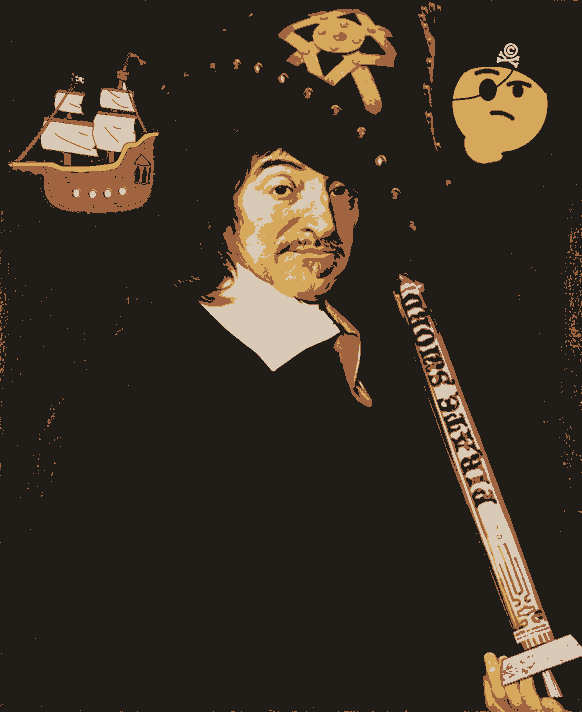
The seventeenth-century French philosopher René “Pretty Fly for a Jesuit Guy” Descartes cared a lot about knowledge, and he cared about justification too. But he was way more worried about certainty—Descartes wanted to put himself and all his knowledge in an absolutely certain position where he couldn’t doubt any of it. In short, he wanted knowledge to be beyond doubt.
That’s a little unusual. Take the idea that the world is round—you probably think you know that, that you know the world is round. And that seems totally reasonable. But are you also sure that the world is round? Are you absolutely, bet-your-kid’s-life-on-it certain that the world is round? Maybe you are, maybe not. I mean, there could be a gigantic worldwide conspiracy going on out there, on the scale of Birds Aren’t Real, whose sole goal is to convince hapless people like us that the world is round when it’s really flat. Probably not, but it could be, and maybe that possibility of being wrong introduces just a tiny bit of doubt, so that you may not be completely certain after all.
Descartes looks at a situation like that and thinks, no, you can’t have knowledge without being certain; you can’t really know a thing unless you can’t doubt that thing. He wasn’t interested in just having good reasons to believe something. He thought that anything you could doubt wouldn’t be worthy of the title “knowledge” in the first place.
That’s what he says here, for example:
